
How Christian Writers Can Use Substack Notes for Effective Growth (And Why You Should)
Moving beyond "platform building" to create moments of genuine connection

Welcome to Part 1 of my Ultimate Guide to Substack Notes, specifically for Christian writers. For more, see Part 2 and 10 Notes Templates. thanks for reading!
There is a tension every Christian writer feels, especially in this modern era.
On one hand, we feel the pressure of the internet age: the demand to be loud, to be everywhere, to build a platform, to “stop the scroll.”
Honestly, it feels exhausting. It often feels like the opposite of the quiet work we are called to do.
On the other hand, we carry a fire. You have been given words that you believe are true. You have been given a message that could help someone. And lighting a lamp just to hide it under a bowl doesn’t feel right, either.
So how do we navigate this? How do we share our work without losing our soul or succumbing to pride?
I believe the answer lies in shifting our perspective from promotion to stewardship.
When we view visibility as vanity, we tend to pull back. We may find ourselves stuck in the endless cycle of introspection, or perhaps we decide to not publish anything at all.
But when we view visibility as stewardship—as faithfully carrying the bread to the hungry—all of that changes. We stop trying to be “famous” and start trying to be findable.
This is why I love Substack Notes.
You see, I’ve found that Notes are the key to discoverability on this platform—and using them is less like shouting through a megaphone and more about the “ministry of the small.” It’s about offering a cup of cool water to the reader who only has thirty seconds to spare.
Over the next two posts, I want to walk you through a different way to approach this tool. We aren’t going to talk about “growth hacking” or “going viral” (I don’t know about you, but I’ve had my fill of that).
Instead, we’re going to talk about connection.
In Part 1 (Today), we will look at the Heart and the Shape. How to write a Note that actually engages with people, rather than just adding to the noise.
In Part 2, we will discuss the Harvest. How to build a sustainable system so you can share consistently without burning out.
While today’s guide is completely free, Part 2 includes my complete “Trellis Toolkit”—the specific patterns and workflows I use to make the most of my writing time, as well as 10 templates to get you started.
Subscribers also get access to my Notes workshop, which covers the same material in a much more digestible format.
Here’s a special discount for those who’ve made it this far:
Thank you so much for your support!
Now, let’s talk about what I mean by “the ministry of the small.”
The Truth About Touchpoints
There are already hundreds of articles about Substack growth. I’m sure you’ve seen them.
But bear with me for a moment, because I want to share something that shifted everything for me.
I say this with the utmost humility, because I’m certainly no guru when it comes to writing. However, I was able to grow The Writer’s Calling from 0 to 4,000+ subscribers in 11 months, mostly due to the Notes feature. In fact, over 90% of my subscribers have come from Notes directly.
This isn’t because I discovered some secret formula, but because I believe I learned to write Notes that actually serve and engage with people.
Note: Before we go further, let me be clear: there’s no single “right way” to write Notes. I’ve seen successful Notes that are longer personal stories, vulnerable moments from daily life, simple questions that spark discussion, or even just images with thoughtful captions. What I’m sharing here are patterns I’ve noticed work consistently—but they’re observations, not rules.
Use what serves you. Ignore what doesn’t.
Alright, so let’s get right to it: When you publish one long-form post per week, you get one moment of connection with your readers. That post might be excellent—you might have poured hours into research, prayer, and careful crafting—but it’s still just one touchpoint.
Now, Notes can multiply those touchpoints in two ways.
First, you can extract Notes from articles you’ve already written (which we’ll cover in Part 2). When you publish that article and pull five key moments from it throughout the week, you create six opportunities for connection instead of one.
Second—and this is equally important—Notes can be standalone thoughts that haven’t yet become articles. Maybe it’s an insight that hit you during morning prayer. A single sentence, or a reframe you discovered in conversation. Not every thought needs 1,000 words to be valuable. Some truths are complete in fifty words. (We’ll talk about what makes these standalone Notes self-contained and powerful later.)
Your article requires thirty minutes of focused attention. Someone has to decide, “I’m going to sit down and read this now.”
That’s a high bar in our fractured-attention world. Many people who would genuinely benefit from your work will never clear it—not because your writing isn’t valuable, but because they’re reading between meetings, during their baby’s naptime, or in the three minutes before their coffee finishes brewing.
A fifty-word Note requires almost no commitment. Someone can absorb it in the space between thoughts. And in those few seconds, you can offer a complete reframe that shifts how they see their work, their calling, or their struggle for the rest of the day.
Notes are your Roman roads. They’re the paths where readers are already scrolling, already seeking, already open to encountering truth. When you share Notes, you’re not compromising depth for reach. You’re creating access points to depth.
The Wrong Way to Think About Notes
As a millennial, I grew up posting updates on Facebook (and MySpace 👴).
These were often little thoughts or things about my day, or what music I was listening to, or a funny meme I’d seen.
Those are all great, but if you’re like me, it might take a little shift in mindset to approach Substack Notes most effectively.
In short, Notes probably shouldn’t fill the same role as your Facebook feed.
You can certainly share personal glimpses, like a picture of your messy desk, a vulnerable moment from your day, or a celebration—truly, whatever you’d like.
Authenticity matters, especially now, and people connect with humans, not content machines. But the most effective Notes usually aren’t stream-of-consciousness thoughts you’re externalizing for your own processing.
They’re not “here’s what I’m thinking about today” unless that thought is developed enough to serve someone else.
The difference is simple: Does this offer something someone can take away?
A status update: “Struggling with my writing today.”
A more effective Note: “Your most impactful writing will never come from squeezing out words from an empty soul. It will flow naturally from a heart that’s been filled through time spent in God’s presence.”
Both are authentic. But only one has the potential to leave the reader somewhere better than where they started.
This is what I mean by Notes being truth delivery systems. They’re self-contained moments designed to serve and engage, not just to be seen.
The Mirror Moment
So what actually makes people stop scrolling?
Most writers think it’s about being clever, controversial, or using the right “hook.” And to be certain, those things can work.
But as Christian writers, our goal isn’t to get likes simply for the sake of it.
We’re looking for connection.
After watching which of my Notes truly connected—not just got likes, but generated real engagement and brought in subscribers who stayed—I noticed something different.
The most powerful Notes act as mirrors. In a flash, readers see themselves.
They don’t just relate to your content intellectually. It’s about that visceral moment of recognition: “How did they know?”
When someone writes:
“Many Christian writers exhaust themselves trying to write FOR God instead of WITH God...”
The writer who’s been grinding through another article at midnight, fighting every word, suddenly feels seen. Someone finally named the exact weight they’ve been carrying. They thought they were alone in this struggle—that everyone else had figured out how to write with joy while they were stuck in performance mode.
That moment of recognition (what I call the Mirror Moment) is what makes someone stop mid-scroll and actually read. Not because you tricked them with a clever hook, but because you spoke to something real they’re experiencing.
People aren’t looking for more information. They’re drowning in information.
Instead, they’re looking for recognition, for someone to name what they’re feeling but can’t articulate.
The Mirror Moment works because it does three things simultaneously:
It validates their experience. “Yes, you’re not crazy. This is real. Others feel this too.”
It promises understanding. If you can name their struggle this precisely, maybe you also understand the way forward.
It creates relief. They’re not alone. Someone else has walked this path and lived to write about it.
This is why the many well-performing Notes often start with struggle, not success. They begin where the reader actually is, not where you want to take them.
The Setup-Turn-Landing Framework
Once you understand the Mirror Moment, the next question becomes: how do you structure it?
I’ve analyzed my highest-performing Notes—the ones that averaged 46 words but generated hundreds of restacks and brought in actual subscribers who stuck around. Almost all of them follow a specific flow that creates a mini-journey in just a few sentences.
Here’s the pattern:
Setup: Name the pressure, false belief, or common struggle
Turn: Use a contrast word (”but,” “instead,” “however”) to signal the shift
Truth: Offer the reframe or Kingdom perspective
Landing: Show what this makes possible or how it changes things
Let me show you exactly how this works with a Note that brought in over 200 subscribers:
“Christian writers often think surrendering to God means abandoning their ‘secular’ interests.
Trading food blogs for Bible studies, or travel guides for devotionals. (Setup)
But true surrender might mean going deeper into your field, serving with greater excellence, loving your readers better. (Turn/Truth)
Because when Christ lives through you, He often transforms how you write more than what you write about.” (Landing)
See how it works? The setup creates immediate recognition.
Countless Christian writers have felt guilty about writing “non-spiritual” content. The turn challenges that assumption. The landing shows them a different way forward.
The pattern creates tension and then resolves it.
Recognition → Challenge → New Possibility.
Here’s another example:
“The internet has enough gold miners. What we need are gardeners. (Setup/Turn combined)
Patient ones. Writers who care about the people behind the clicks. (Truth)
Who know the best fruit often grows where no one’s watching.” (Landing)
This one compresses the structure but maintains the same emotional arc. It names the exhausting reality (everyone mining for viral gold), offers an alternative identity (gardener instead of miner), and lands on a truth that brings peace (faithful work matters even when it’s unseen).
The key is that contrast word—”but,” “instead,” “however,” “actually.” It signals to the reader that a change is coming. That the burden they’re carrying might not be necessary. That there’s another way to see this.
Without the turn, you just have commiseration: “Writing is hard. We’re all struggling. Isn’t this exhausting?”
With the turn, you offer transformation: “Writing is hard. But it doesn’t have to be this particular kind of hard. Let me show you what I’ve learned.”
Making It Readable
Before anyone reads a single word of your Note, they see its shape.
And shape matters more than you might think.
When someone pauses their scroll, their brain makes an instant calculation: How much effort will this require? If your Note looks like a wall of text—even if it’s only 50 words—their brain says “too much” and their thumb keeps moving.
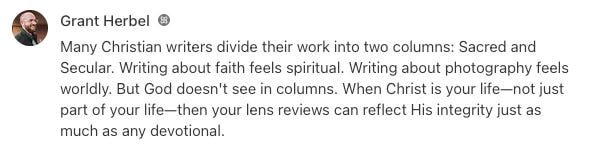
Compare these two versions of the exact same content:
Version A (The Wall):
Version B (Breathing Room)
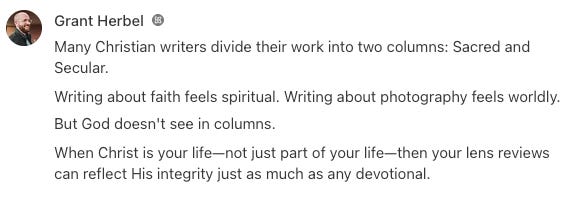
Same words. Completely different reading experience.
Version B feels lighter, more inviting. Each line break gives the eye a micro-rest. The important pivot—”But God doesn’t see in columns”—gets to stand alone and land with impact.
These days more than ever, you’re not just writing words. You’re creating a reading experience. And part of that experience is making it feel effortless, even when the truth you’re sharing is profound.
Here are the formatting principles I follow:
One thought per line. Don’t cram multiple ideas into a single paragraph. Let each thought breathe.
Break at natural pauses. Read your Note out loud. Where do you naturally pause for breath? That’s where you break the line.
Let important lines stand alone. When you have a line that needs to hit hard—your turn, your main truth, your landing—give it its own line. White space creates emphasis.
Keep it between 30-60 words. This isn’t a rigid rule, but it’s a helpful guideline. Shorter than 30 often feels incomplete. Longer than 60 starts to feel like work.
The Complete Thought Test
Before you post any Note, run it through these three questions:
Could someone who’s never heard of me understand this?
Your Note shouldn’t require knowledge of your previous work, your theological framework, or what you wrote about last week. It should be a self-contained thought that anyone can receive.
Is there one clear takeaway?
A Note isn’t the place for nuance and multiple perspectives. Save that for your articles. A Note should leave the reader with one clear thought they can carry with them.
Does this leave the reader somewhere better than where they started?
This is the most important question. Did you just name their problem, or did you offer them hope? Did you just commiserate about the struggle, or did you show them a path forward?
If your Note passes all three tests, it’s ready. If not, keep refining.
Remember: A Note shouldn’t just be a teaser for longer content. “I wrote about this topic today, link in comments” isn’t serving anyone. It’s just announcing that you have something to sell.
Instead, offer a complete thought. Give them something they can use right now, whether or not they ever click through to your article.
Make the Note itself valuable.
When you do this consistently—when every Note offers real value instead of just promoting your “real” work—people start to trust you.
They think, “If their free thoughts are this helpful, what might their deeper work contain?” And they subscribe not because you convinced them, but because you’ve already served them.
What This Makes Possible
I used to think of visibility as a necessary evil. Something I had to do to be a “successful” writer but that always felt slightly gross. Like I was constantly promoting myself, constantly asking for attention.
But when I shifted to thinking of Notes as ministry, as offering cups of cold water to thirsty readers, the pressure lifted. The guilt disappeared.
Because I wasn’t promoting myself anymore. I was serving people.
Every Note became an opportunity to lift a burden someone was carrying. To name a struggle they thought was theirs alone. To lift up Christ by direct name or by simply reminding people of truths they knew but had forgotten in the fog of daily life.
When you approach Notes this way—and this is important—growth becomes a byproduct of service rather than the goal itself.
You stop checking stats obsessively because you’re focused on the person who might need exactly these fifty words today. You stop comparing yourself to other writers because you’re not competing—you’re serving different tables at the same feast.
The church doesn’t feel guilty about promoting its service. And you don’t need to feel conflicted about making your work findable for those who need it.
When your goal is to present truth, strategic visibility isn’t vanity, but stewardship.
Your Next Step
Look at your last published article. Even before you move on to something else.
Find one moment in it that still resonates with you. One turn you made, truth you articulated, or reframe you offered.
Copy it into a new document.
Now ask yourself: Can this stand alone? Does it need a bit more setup to make sense? Does it need a clearer landing?
Refine it using the Setup-Turn-Landing structure. Format it with breathing room. Run it through the three-question test.
Then post it.
Not tomorrow, or after you’ve perfected it. Now.
Someone is scrolling through their feed right this moment, carrying a weight that your fifty words could lift.
Make it easy for them to find you.
In part 2 of this post, we’ll dive into the practical system—how to extract multiple Notes from every article, how to batch your workflow so it takes just 30 minutes per week, and for paid subscribers, the specific templates and patterns that consistently connect.
But for now, start with one Note.
Ministry begins not with grand strategies, but with simple faithfulness in small things.
In Part 2: Learn the “harvest” approach to Notes—how to extract a week’s worth of valuable content from every article you write, plus the sustainable workflow that takes just 30 minutes per week. Paid subscribers will also receive my complete Trellis Toolkit with proven templates and patterns that consistently connect with readers.
Thank you for reading, and God bless!
Grant
This is SO helpful. I appreciate your thought & experience shared with us. Can't wait to apply.
Really connected to visibility as stewardship!
& Recognition → Challenge → New Possibility (which God Always provides).
Thanks again!
From promotion to stewardship. From “famous” to “findable.” Thank you for these helpful pointers, Grant! 😊